Essential oil extraction | The most widely used techniques

Essential oil extraction | The most widely used techniques
In this article we will explain which techniques are most commonly used for the extraction of essential oils, focusing our attention on the extraction of Palo Santo essential oils from the Lynpha Vitale store.

Essential oils, also known as fragrant oils, are aromatic oily liquids extracted from different parts of plants: bark, fruits, flowers, leaves, buds and seeds. They are used mainly for aromatherapy, a holistic practice that helps restore energetic balance through the use of aromatic essences.
In recent decades, essential oils have become increasingly sought after thanks to the expansion on the market of room diffusers, tools that release aromas into the air quickly and automatically.
Essential oils can also be used during massages and baths, taking care to dilute them in a carrier oil, such as almond oil.
Properties of essential oils (focus: Palo Santo essential oil)
Knowing the properties of essential oils helps us choose the ones best suited to us. Each essential oil, in fact, has specific characteristics. Lavender essential oil, for example, is mainly recommended for its calming properties, eucalyptus oil as a decongestant, and so on. Among the most appreciated and precious essential oils are also those of Palo Santo.
Palo Santo essential oil has numerous soothing and anti-inflammatory properties and is recommended both as a massage oil and for aromatherapy. Its fragrance gives immediate relief and inner relaxation.
Essential oil extraction | What are the best-known techniques?
The main method for extracting essential oils is steam distillation (which we will explain later). Other common techniques are:
- Cold extraction of essential oils (also known as cold pressing or cold pressure): this is the method used to extract essential oils from citrus fruits. Through mechanical pressure, the essential oils are pressed from the rind or peel.
- Essential oil extraction with absolue (non-toxic) solvent, a system in which the plant material is treated with a solvent that binds to the plant fibres and creates a paste called concrete, which is then distilled to separate the solvent from the essential oil.
There are other methods of essential oil extraction (such as alcohol extraction) which, however, do not result in a pure essential oil. In alcohol extraction, for example, alcohol particles still remain in the solution obtained.
Methods for extracting Palo Santo essential oils
To extract Palo Santo essential oil, steam distillation is used, a technique that makes it possible to obtain a pure essential oil.
At Herborea we extract Palo Santo oil from both the wood and the fruit of Bursera graveolens using methods that we have refined over the years.
How to extract essential oil from Palo Santo wood
1. Preparing the wood - The wood collected in the dry forest by our collaborators in Ecuador or purchased from Peruvian companies that work in an eco-sustainable way is cut into thin strips, so that the contact surface between the solvent (steam) and the raw material is greater.

2. Distillation - In this stage of the process, we place the wood flakes in the distiller using a technique refined over the years that allows the steam to pass through the wood fibres and carry oil and steam up into the distiller coil.
3) End of distillation and yield - At the end of the process, the water, which has a higher specific weight than the oil, settles at the bottom, while the oil forms a surface layer that can be collected easily.
How to extract Palo Santo essential oil from fruit
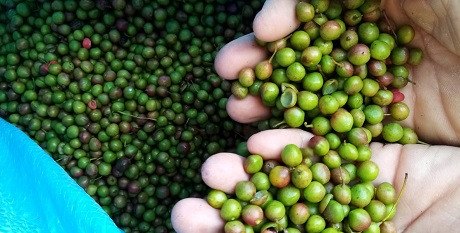
1. Harvesting - Our collaborators in South America harvest Palo Santo fruits only during a specific period of the year, namely when they are not too ripe. In order not to interfere with the natural course of the ecosystem, we collect only 30% of the fruits present on the trees.
2. Preparing the fruit - Once cleaned by hand of any impurities such as stems and twigs, the fruits are crushed, to increase the contact surface between the solvent (steam) and the raw material.
3. Distillation - The crushed fruits are placed in the distiller, which allows the steam to pass through their pulp, capture the essential oil and extract it. In this case too, the extracted oil will be separated from the aromatic water.

The story of Herborea Palo Santo Amarillo essential oil
At Herborea, we were the first in Europe to professionally distil Palo Santo wood essential oil from Ecuador and Peru. As the project developed, we decided to take our distiller to our partners in South America to allow extraction directly at the place of collection and preserve the beneficial properties even further.
The essential oils of our Palosanto® brand are extremely sustainable products, as they are obtained from the parts of the wood that, for commercial reasons, could not be used to make incense sticks.
Our 100% natural products
Discover all the essential oils in the Palosanto® line and complete your purchase with our nebuliser, an ultrasonic diffuser ideal for aromatherapy and for gently purifying rooms.
If you have any questions for us, please do not hesitate to write us an e-mail, we will reply as soon as possible.